
The Ace of Swords: Double-Edged Promise

Hey, friends! I have been wanting to a deep dive on each of the four suits in the Minor Arcana for a while now. Since my intuition has been directing me to delve a bit more into the Swords, I thought that I would start with that one.
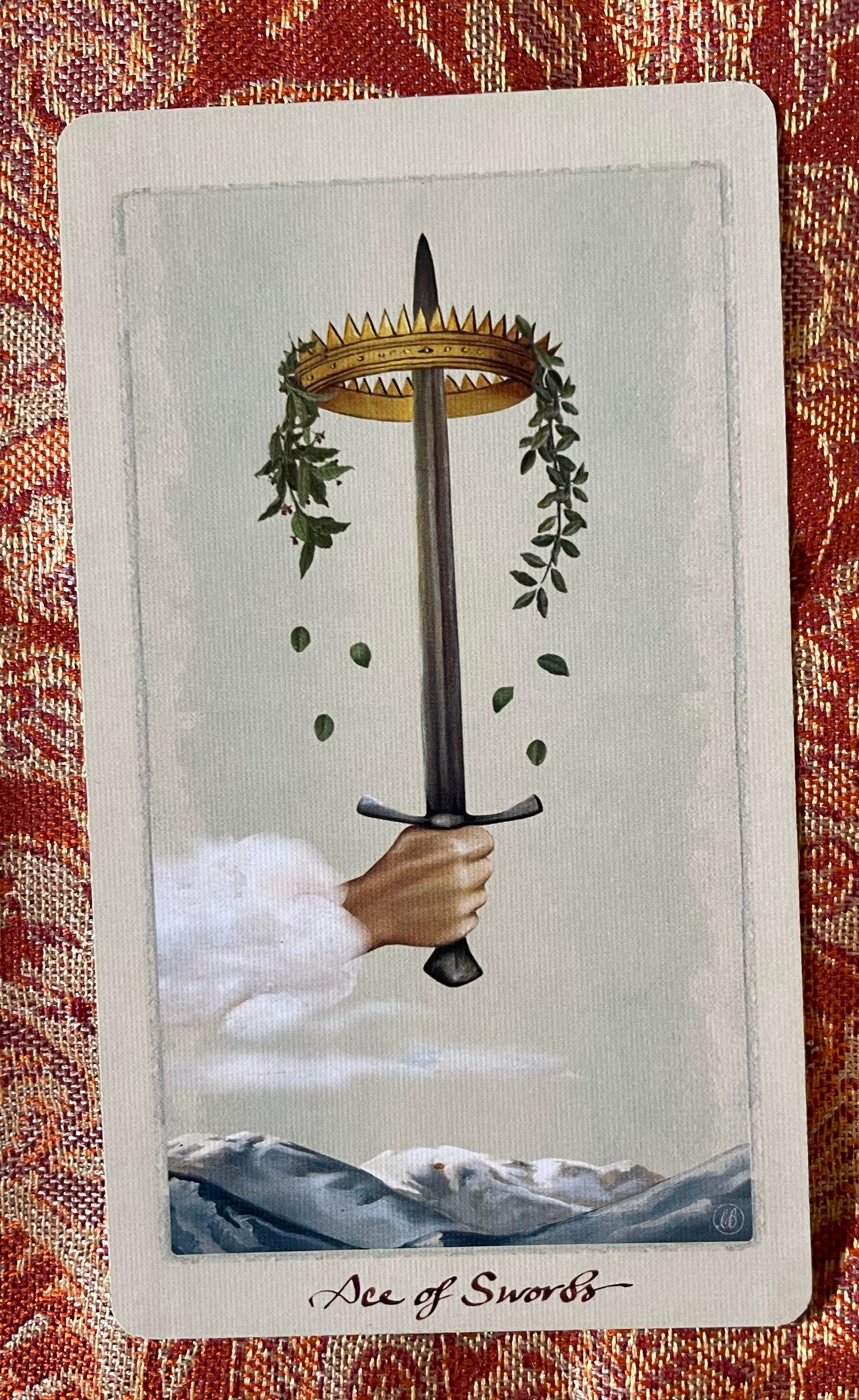
For this series as well as for the rest of the month of December, I will be using the Pagan Otherworlds Tarot Deck. I bought this deck at the shop Psychic Sister in Olympia, Washington back in 2018 (they are an excellent shop; if you ever get the chance, you should go and get a reading there!). To this day, the Pagan Otherworlds deck is one of my favorites. From the sumptuous, buttery texture of the cards, to the sharp yet subtle quality of the illustrations, it’s a can’t miss deck for me personally. However, if you’re looking for representation or diversity, this deck isn’t one where you’re going to find that. Additionally, the pip cards (those in the Minor Arcana) don’t have the representative illustrations popularized by the Rider-Waite-Smith tradition. Overall, though, not every deck can be everything. This was the deck that kept telling me to shuffle it for December, and I listened.
So let’s get to it.
The Ace of Swords is a new beginning in a mental, intellectual, and creative sense. It’s a blank canvas. A new journal. A document with a blinking cursor. A job interview, offer, or audition. New beginnings are exciting–they always have been to me, anyway. There is great potential for success, as evidenced by the crown encircling the sword on this version of the card. One of my favorite quotes is from Anne of Green Gables, where Anne Shirley says, “Tomorrow is always fresh with no mistakes in it.” But here’s the thing about beginnings, they can go in different directions. Like a sword, beginnings are double-edged.
Unfortunately, we humans have many ways that we can bungle the beginning of something before we really even know what it is. You can suck the fun out of a beginning by placing unhealthy, unrealistic expectations upon it. For example, you can act as an editor while writing a first draft to the point where you mentally suffocate your creativity. On a first date, you could tell yourself a story about how you’ve just met “the one” and miss a veritable Soviet parade of red flags. Or, because you’re not paying attention, you let inspiration blow right by you because you’re not mentally available to notice its still, small voice.
Whatever chance your Ace of Sword might represent for you, the underlying message is for you to “be on the watch” as Charles Bukowski says. Try to access whatever way you can to cut through mental fog and clutter. Question the stories that you habitually tell yourself, especially if they leave you feeling helpless or give agency to another person or to a corporation or government. And add an equal measure of compassion for yourself and others; no mental breakthrough is worthwhile if it seeks to punish or demonize individuals or groups.
I suggest that you read this Bukowski poem "The Laughing Heart" if you haven’t already. Yes, I know and agree that he is problematic and gross in myriad ways, but I still love this piece, and I think it reflects the message of The Ace of Swords.
Thanks for reading, and I’ll be back next time to riff on The Two of Swords.
Layla