
The Page of Swords is Doing Their Own Research
Thoughts on the court card

Hello!
I’m back this week with a deep-dive on the Page of Swords, or at least, as deep as the Page of Swords gets.
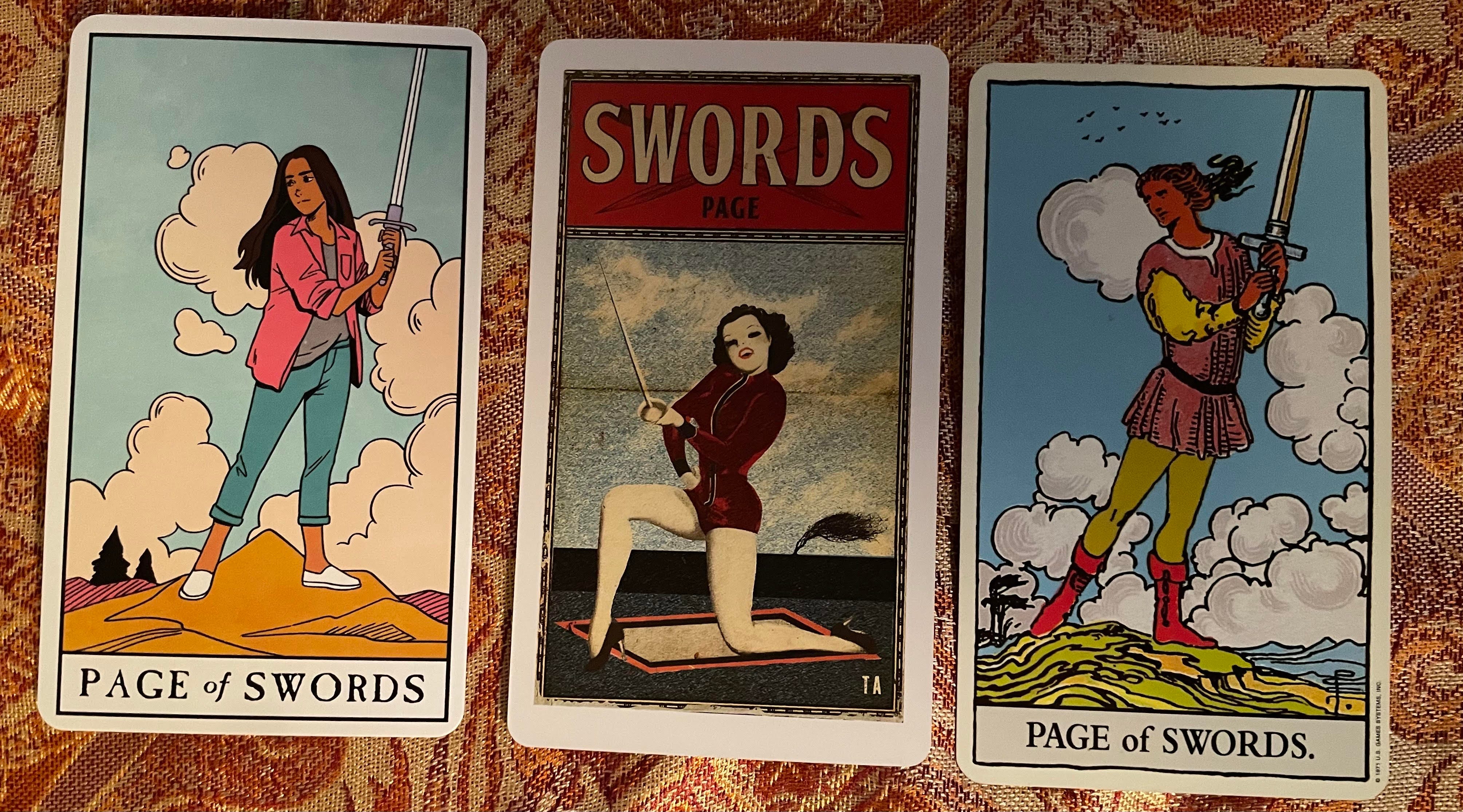
The Page of Swords from the Modern Witch Tarot, the Pulp Tarot, and Smith-Rider-Waite Tarot (left to right).
As I have written and said in different places, I always think of the Page of Swords as being the college freshman of the tarot, or truly, the rebellious teenager of the court cards, even when compared to the other pages. The Page of Swords is looking for new ideas, new ways of being, and new things to believe and to believe in.
In many ways, the Page of Swords reminds me of when I was fifteen, and I discovered 1977 British punk rock. Suddenly, without having much context or frame of reference, I wanted to be a punk. I wore steel-toed Doc Martens, smoked cigarettes, drank black coffee, and generally viewed everything with jaundiced disdain. This was all in the late Nineties, the early days of the Internet, so I was independently researching this time, feeling like the musical world I was discovering was all my own. Developing this knowledge and cultural awareness, incomplete and erroneous as a lot of it may have been, made me feel connected to something deeper than the Britney-Christina-Justin cultural moment that my peers were spun up in. Really though, like most fifteen year olds, I was incredibly naive and basically playing dress-up.
To this day, I love studying different movements in pop culture and particularly in music as a response to political and social change. It remains my jam (just like the band The Jam; they’re really good). Punk will always have a special place in my heart. Now, though, I can acknowledge the process that I was going through at the time. I was building knowledge about a certain domain in service of building an identity and a sense of belonging.
This blend of curiosity, idealism, and needing to fit reality into a certain ideology or narrative is emblematic of the Page of Swords. What the Page of Swords doesn’t really possess, and a quality that doesn’t really appear in the Swords court cards until we reach the Queen, is patience and the willingness to let people, situations, and dynamics unfold without jumping to label, categorize, or judge them. Without lumping them into piles of Self and Other, Us and Them. On top of all that, the Page of Swords has yet to outgrow the tendency toward righteous indignation or victimhood. At their worst, the Page of Swords nurses a chip on their shoulder.
As an elementary teacher, this year I have often spoken to my students about the difference between reacting and responding. When we react, we act quickly and often thoughtlessly, not giving ourselves a chance to assess our emotions before we speak or act. When we respond, we take a little bit more time to think whether what we do or say will help us solve a problem or help us meet a goal. While it’s unreasonable to demand of ourselves that we always respond and never react, it’s best if we can tip the scales toward responding more often.
Why do I mention this? Well, the Page of Swords strikes me as incredibly reactive. On the Smith-Rider-Waite card, the Page is about to swing their blade, knees slightly bent in a defensive stance. The clouds behind them symbolize mental turmoil and changeability. The Page stands on a ridge, looking down on the panorama behind them, implying that they are somewhat removed from the context that surrounds them, looking down on life from above, kind of like a fifteen year-old who knows how to solve all of the world’s problems. Ultimately, the Page of Swords won’t be able to fully access their wisdom until they learn to slow down, to respond more and react less.
Coming back around to the title that I chose for this post, “The Page of Swords is Doing Their Own Research,” I chose that for a reason. In our current political climate, I notice many Pages of Swords out there in the online ether and in real life. I think that right now we see far too many people falling prey to flawed information and outright lies by bad actors seeking to make money or grow their influence. A lot of these modern day Pages are intelligent but undereducated in terms of how to critically assess the Instagram post, the podcast, or the influencer whose content that they are imbibing. At the same time, we also see a lot of people, many of them but not all of them young, judging and chastising others for their differing opinions and in the process betraying their lack of comfort with nuance. Finally, and most chillingly, we see many young men joining the Christo-fascist far Right, presumably because it gives them a sense of belonging, it validates their centrality and identity, and neatly organizes a complex world into discrete categories of Us and Them.
So, if someone is trying to get you to hate a certain group of people, to live your life within narrow, proscribed parameters, to take expensive supplements, to make sudden, drastic changes to your lifestyle, then you may have moved into shadow territory of the Page of Swords. And yes, there is plenty wrong with the American medical establishment, but if you’re outsourcing your healthcare to a stranger on a social media reel instead of actually talking to an expert, then you’re getting played. Reactive people are easy to manipulate and control.
My fervent hope is that we can all collectively mature into Queen of Swords territory, and soon. But more on that in the next couple of weeks.
Thank you as always for reading. I appreciate each and every one of my readers. As ever, I would love to hear how this interpretation landed for you and what other layers you may have to contribute.
XOXO
Layla
Reading: Atlas of the Heart, by Brene Brown
Listening to: Phantogram, Memory of a Day